Agatha Christie is not merely the queen of cozy mysteries — she is the best-selling fiction writer of all time, surpassed in publication numbers only by the Bible and Shakespeare. With over 2 billion books sold in more than 100 languages, she single-handedly defined what a cozy mystery is and set the standard that every author in the genre measures themselves against.
Who Was Agatha Christie?
Dame Agatha Mary Clarissa Christie was born on September 15, 1890, in Torquay, Devon, England. She began her first detective novel, The Mysterious Affair at Styles, in 1916 while working as a nurse during World War I — reportedly after a challenge from her sister who bet she couldn't write a good mystery. She won that bet, and then spent the next five decades writing 66 detective novels that would permanently reshape popular fiction.
Christie was famously private and gave few interviews, preferring to let her books speak for themselves. She was married twice — first to Colonel Archibald Christie (from whom she took her pen name), then to archaeologist Sir Max Mallowan, whose digs in Iraq and Syria inspired several of her most beloved novels. She died on January 12, 1976, at the age of 85, having never stopped writing.
The Two Great Detectives
Hercule Poirot
Poirot is Christie's most famous creation — a fastidious Belgian detective with an egg-shaped head, immaculate moustaches, and an absolute faith in "the little grey cells" of the brain over physical evidence. Introduced in The Mysterious Affair at Styles (1920), Poirot appeared in 33 novels and more than 50 short stories, making him one of the most-portrayed fictional characters in television and film history. Christie herself grew so tired of him that she called him "a detestable, bombastic, tiresome, egocentric little creep" — yet continued writing him for five more decades.
His final case, Curtain, was written during World War II and locked in a bank vault until Christie instructed it to be published posthumously. When it appeared in 1975, the New York Times gave Poirot a front-page obituary — the only fictional character ever to receive one.
Miss Marple
Jane Marple is Christie's second great detective, and in many ways her more personal creation. An elderly spinster from the village of St. Mary Mead, Miss Marple solves murders through her encyclopedic knowledge of human nature drawn from decades of observing village life. Christie said Marple was based partly on her step-grandmother and partly on the sort of elderly women who "always think the worst of everyone and are usually right."
Miss Marple appeared in 12 novels and 20 short stories. Unlike Poirot, she never leaves England and solves crimes through gossip, observation, and making connections between crimes and incidents she has known in the village. She is the archetypal cozy mystery protagonist — amateur, underestimated, and almost always correct.
The Best Agatha Christie Books to Start With

And Then There Were None (1939)
Ten strangers are lured to an isolated island and begin dying one by one according to a nursery rhyme. The world's best-selling mystery novel and Christie's own favourite of her works. Unlike most of her books, there is no series detective — just ten suspects, all of whom may be the killer. An absolute masterpiece of plotting that has never been surpassed.
Find this book →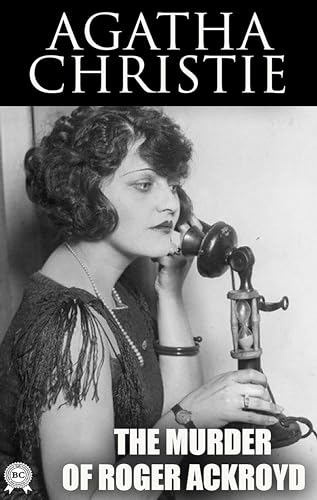
The Murder of Roger Ackroyd (1926)
The book that made Christie famous and caused a genuine literary controversy. Without spoiling it: the twist ending was so audacious that critics debated whether it was "fair play" for years. It is now considered one of the greatest mystery novels ever written. Start here if you want to understand why Christie was so revolutionary.
Find this book →
Murder on the Orient Express (1934)
Poirot is stranded on a snowbound train when a passenger is murdered. Every suspect has an alibi. The solution is one of the most celebrated in detective fiction — audacious, fair-play, and deeply satisfying. Adapted multiple times for film and television, including Kenneth Branagh's 2017 film.
Find this book →
The Murder at the Vicarage (1930)
Miss Marple's debut novel, set in the village of St. Mary Mead. The local vicar narrates, making it one of Christie's most charming and character-rich books. The perfect introduction to cozy mystery village fiction — and to the genre's single greatest amateur detective.
Find this book →Christie's Influence on Cozy Mysteries Today
Almost every convention of the modern cozy mystery traces directly to Agatha Christie. The amateur sleuth who outwits professionals? Miss Marple. The village setting where everyone is a suspect? St. Mary Mead. The cast of colourful characters with hidden secrets? Every Christie novel. The fair-play mystery where all the clues are present for the reader to find? Christie codified this as a moral requirement of the genre.
Today's cozy mystery authors openly acknowledge their debt. When Richard Osman set his Thursday Murder Club in a retirement village with elderly protagonists, he was consciously following Christie's lead with Miss Marple. When Louise Penny built Three Pines as a recurring community in her Gamache series, she was doing what Christie did with St. Mary Mead. The DNA of modern cozy mysteries is almost entirely Christie's.
The Christie Record
- 2 billion+ books sold worldwide
- 100+ languages translated into
- 66 detective novels written
- 14 short story collections
- The Mousetrap — world's longest-running stage play (1952–present)
- Most translated individual author in history according to UNESCO
Explore modern cozy mysteries inspired by Agatha Christie
Browse Cozy Mysteries →Frequently Asked Questions
Do I need to read Agatha Christie's books in order?
For the most part, no. Christie's novels are designed to stand alone, and you can pick up any Poirot or Marple novel without having read the others. However, reading them in publication order gives you the pleasure of watching her craft develop and become more sophisticated over time. The ABC Murders, Evil Under the Sun, and Crooked House are all excellent choices for any starting point.
What is Agatha Christie's most surprising book?
The Murder of Roger Ackroyd is the most controversial and surprising. And Then There Were None is the most structurally audacious — there is no traditional detective at all. Endless Night (1967) is her darkest and most psychologically complex, quite different from her usual style.
What happened during Agatha Christie's famous disappearance?
In December 1926, Christie disappeared for 11 days following a period of personal crisis — her husband had asked for a divorce, and her mother had recently died. She was eventually found at a hotel in Harrogate, registered under the surname of her husband's mistress. Christie herself never spoke publicly about the disappearance, and its true cause remains uncertain. The incident has inspired numerous fictional adaptations.