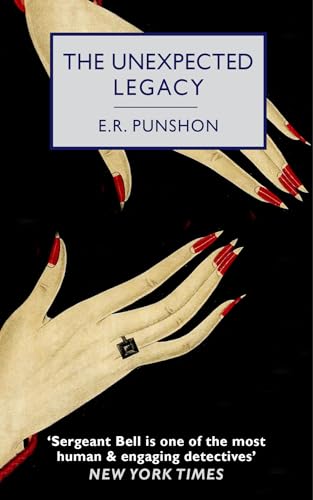
The Unexpected Legacy: A Carter & Bell Mystery
About The Unexpected Legacy: A Carter & Bell Mystery
First novel in E. R. Punshon’s Inspector Carter & Sergeant Bell Scotland Yard detective series, out of print for almost a century‘Sergeant Bell is one of the most human and engaging detectives that it has been our good fortune to encounter’ New York Times; ‘A duo portrayed with a sardonic touch that seems ahead of its time’ Martin Edwards, The Golden Age of Murder; ‘Carter and Bell are one of fictions’ most engaging heroes’ Saturday Review‘The Unexpected Legacy really thrills… involves the death of a man found battered, shot at and dosed with arsenic’ The Daily MirrorThere are a myriad ways to commit murder. Usually a single method is sufficient. A stiletto to the back of the neck; Being beaten to death with a blunt instrument; A drop of poison in a cocktail. All would do the trick. The man found dead one summer’s morning on London’s Windmill Common had been shot, his head smashed in and had ingested arsenic. Why had the unfortunate victim been attacked in three murderous ways? The only clue found was on the bloodied corpse – a photograph of a young woman, a Miss Doris Yorke. Miss Yorke had recently been informed she was to be the recipient of a substantial – and wholly unexpected – legacy. Scotland Yard’s most incongruous duo, the deft promotion-hunter Inspector Carter and intuitive Sergeant Bell, get to work.
About the AuthorErnest Robertson Punshon was born in East Dulwich, London, in 1872. He experienced a rather chequered early career, failing as an office junior aged fourteen. He then tried his hand as a farmer in Canada, this also was unsuccessful and he returned to England penniless. In desperation he turned to writing and won one of the first open writing competitions. His first novel was published in 1901 and his first mystery novel in 1907. However, Punshon’s best writing belongs to the Golden Age of crime fiction, and he was admitted to the exclusive ranks of the ‘Detective Club’ in 1933. His first series characters were Inspector Carter and Sergeant Bell, an incongruous pair of Scotland Yard detectives who starred in five novels. Carter is essentially a hollow man, thrusting and showy, but seeing no more than the surface of things and easily led to false conclusions. His real gift is for self-promotion and depends on his sergeant to solve their cases, though taking the credit himself. Sergeant Bell is astute but unassertive, a melancholic man who resigns himself to his superior’s need to bolster himself at the expense of a subordinate. Punshon’s most popular literary creation was the sophisticated, Oxford-educated Scotland Yard detective, Bobby Owen. The ever-methodical Bobby starred in over thirty-five novels and progressed through the ranks to Commander. Today, he is perhaps the least well-known and researched of this influential group of crime writers. E. R. Punshon continued to write until he was eighty-three and died in Streatham, London in 1956.
Praise for ‘E. R. Punshon’‘What is distinction? The few who achieve it step – plot or no plot – unquestioned into the first rank. We recognized it in Sherlock Holmes, and in Trent’s Last Case, in The Mystery of the Villa Rose, in the Father Brown stories and in the works of Mr E. R. Punshon we salute it every time.’ Dorothy L. SayersThe Cottage Murder‘Readers on the lookout for a story of crime which is well written and well-constructed may be confidently recommended to The Cottage Murder’ The GuardianThe Conqueror Inn‘Death walks in the moors… An extremely intricate crime puzzle with an equally intricate solution’ New York TimesThe Crossword Mystery‘Bafflement of a high order and a truly startling finish’ New York Times