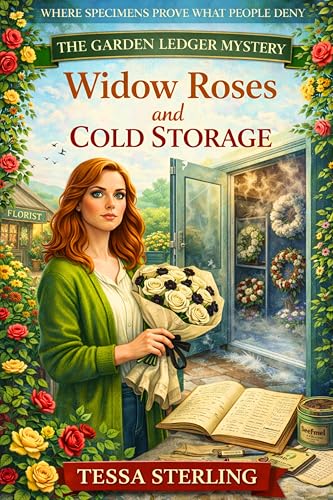
Widow Roses and Cold Storage: A Small-Town Garden Cozy Mystery Book 3
About Widow Roses and Cold Storage: A Small-Town Garden Cozy Mystery Book 3
A flower shop should smell like celebration, not endings. My name is Calla Hawthorn, and Thornewood Reach is still learning it cannot file me under “temporary.” I inherited The Garden Ledger, a rare bookshop with a living herbarium and a glasshouse that makes the town look charming in photographs.
The town would prefer I focus on pressed flowers and polite smiles. Then the florist dies in her own cold-storage room. The official version is neat.
A tragic accident. A terrible fluke. The kind of story that keeps tourists booking garden weekends and keeps the council’s “heritage” brochures clean.
But nothing about the scene feels accidental, not the timing, not the locked-in calm, and definitely not the one rose that stands out like a warning. A white rose with black-tipped petals. People want it to be a miracle variety.
It is not. It is stress. Temperature control.
Pigment manipulation. The kind of work that requires a specific setup and a person who knows how to hurt something slowly while making it look like nature did it. The paper trail is worse.
A vintage seed catalogue turns up with a 1940s wedding registry tucked inside, and the names do not match the town’s official history. Someone has been changing identities quietly, the way you change a label when you want a plant to look respectable. Birdie’s handwriting shows up in the margins like she was trying to warn someone, or protect them.
And if Birdie was involved, it was never for gossip. It was for safety. Ozymandias, my heat-seeking Sphynx, keeps ending up exactly where he should not be, curled against warm pipes and vent grates as if he owns the building.
He is vain, demanding, and irritatingly good at turning my attention toward the one spot everyone else wants me to ignore. Silas Vance, a marine ecologist with tide charts in his head and dirt under his nails, brings me erosion data that makes my stomach drop. The cliffs are being managed.
Not for the town. For specific parcels. For profit.
The deeper I dig, the clearer it becomes that the florist did not die because she was careless. She died because she knew who in Thornewood Reach has been rewriting people’s lives, and who still benefits from keeping the past quiet. In a town where weddings and funerals share the same supply chain, the truth is cultivated like a rare bloom.
Protected, priced, and stolen.